DJ vs Band: Deciding the Wedding Music Vendor
Quick answer: Default to a high-quality DJ unless you have a specific reason to prefer a band. A DJ runs roughly $1,200 to $6,500, plays an unlimited library across all guest ages, and handles MC duties without breaks. A reception band runs $5,000 to $35,000 and delivers live-performance energy a DJ cannot, which is worth it when music is a top priority, the budget comfortably clears $7,000, or live music matches your wedding's aesthetic and culture. Below a $7,000 music budget, the DJ almost always wins.
The music vendor decides the energy of the wedding more than any other vendor. The food can be excellent and the floor can stay empty. The DJ or band can be middling and the floor stays packed all night. The investment in the music vendor is one of the highest-leverage line items in the entire wedding budget.
I owned a flower shop for fifteen years and worked alongside roughly six hundred wedding music acts in that time. I have watched the same room get a mediocre DJ and an excellent band, and I have watched the same room get a mediocre band and an excellent DJ. The variable that mattered most was almost never DJ-versus-band. It was the specific person or group, regardless of category.
That said, the categories themselves do have real differences. What follows is the practical breakdown of when each is the right choice, what each costs, and what each does well that the other does not.
Here is the side-by-side before the detail.
| Factor | Wedding DJ | Wedding band |
|---|---|---|
| Typical 2026 cost | $1,200 to $6,500 | $5,000 to $35,000+ |
| Music range | Unlimited recorded catalog across every era | Curated live setlist that picks a lane |
| Energy | Consistent, reads the floor track by track | Live-performance peak recorded music cannot match |
| Continuity | Plays continuously, no breaks | 3 to 4 sets of 45 minutes with breaks between |
| Space and power | Compact, flexible, low power needs | Needs a stage, stable power, longer setup |
| MC duties | Almost always included | Band leader handles it, or a separate MC (ask first) |
| Best for | Budgets under $7,000, mixed-age guests, specific recorded songs, smaller or outdoor venues | Music-priority budgets above $8,000, 200+ guests, a live-music culture or aesthetic |
Source note: cost ranges reflect 2026 major-market pricing. For benchmarks, The Knot's DJ vs band cost study reports an average live band near $4,500 against an average DJ near $1,800, and WeddingWire's cost guides track similar splits. Major markets add roughly 30 to 50 percent.
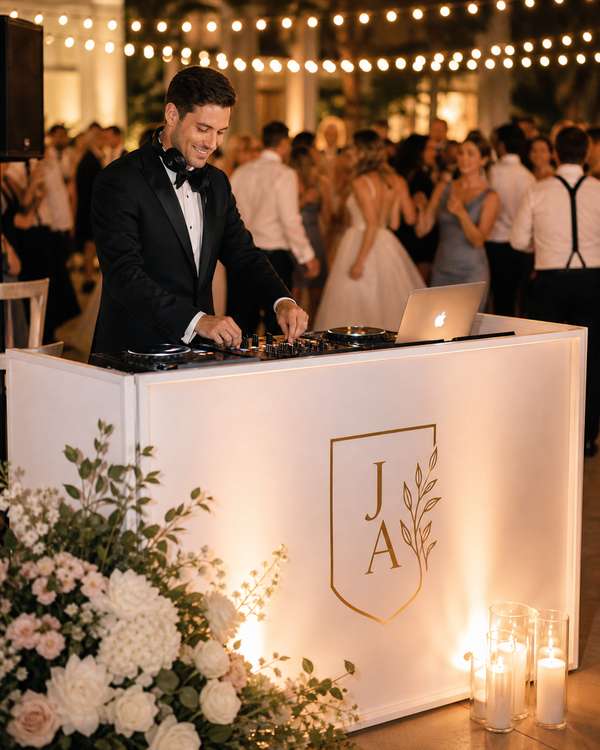
The cost reality
Pricing for major American markets in 2026.
DJs:
- Solo DJ, basic setup: $1,200-$2,500
- Solo DJ with MC services and upgraded sound: $2,500-$4,000
- Top-tier DJ with full lighting package: $4,000-$6,500
- Major-market premium: add 30-50%
Bands:
- Three-piece acoustic band (often ceremony or cocktail hour only): $1,800-$4,000
- Five-to-six-piece reception band: $5,000-$10,000
- Eight-to-ten-piece band with horns: $10,000-$18,000
- Premier or destination-level band: $18,000-$35,000+
- Major-market premium: add 30-50%
The cost difference is the structural difference. A typical reception band is 3-5x the cost of a DJ. The decision is rarely "which would be better"; it is usually "what fits the budget, and within that, which category."
What a DJ actually does
A wedding DJ does more than play recorded music. Almost every working DJ also functions as the master of ceremonies (MC), which is a separate skill from music selection.
Their job at the wedding:
- Music selection across the entire reception. From cocktail hour through dinner background to dance floor energy and ending. A working DJ has a library of thousands of tracks and reads the room in real time.
- MC duties. Announcing the grand entrance, introducing toasts, cueing the first dance, parent dances, cake cutting, bouquet toss. The DJ runs the timing of the reception's flow.
- Sound system management. The DJ's setup typically includes the speakers used for the entire reception, including for toasts and announcements.
- Coordinating with the planner and other vendors. Working with the planner on timing transitions; coordinating with the photographer on cued moments; working with the venue on noise ordinances.
A good DJ reads the floor and adjusts. They build energy, hold it, give the older guests a slow song to come back to, then ramp up again. The skill is in the rhythm of the reception, not just the songs.
A bad DJ plays a generic playlist regardless of room response, talks too much, or talks too little. The bad DJ is a real risk because most couples cannot evaluate a DJ from a sample; you have to see them work or trust strong references.
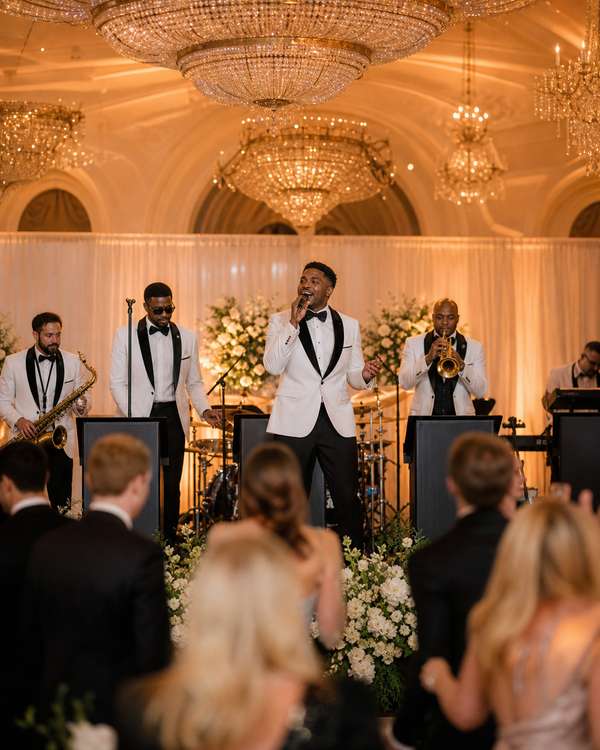
What a band actually does
A wedding band brings live performance energy that recorded music cannot replicate. The right band turns the dance floor into a different kind of experience.
Their job:
- Live performance. The thing only they can deliver.
- Repertoire across genres. A working wedding band can play across decades and styles: Motown, classic rock, Top 40, R&B, country if needed. Bands typically curate their setlist around the couple's preferences.
- Reading the room and adjusting. Same skill as a DJ, executed differently. A good band shifts energy by changing tempo, instrumentation, and song selection in real time.
- MC functions. Most bands have a designated band leader who handles announcements, similar to a DJ. Some bands work with a separate MC for these moments; ask in advance.
- Sound system and stage setup. Bands bring their own gear and are typically more elaborate to set up and break down than a DJ.
The trade-off: bands have shorter sets than DJs. A typical wedding band plays three to four 45-minute sets with breaks in between. During breaks, the band's sound system plays recorded music (sometimes the band brings a backup playlist; sometimes the venue's system runs). The dance floor energy can dip during breaks.
A good band fills the room. A bad band is more painful than a bad DJ because the cost was higher and the air feels wronger when live performance is mediocre.
When a DJ is the right call
A few scenarios where a DJ is clearly the better choice.
Tight budget. $1,500-$3,500 for music versus $6,000+ for a band. If the music budget is under $5,000, hire a quality DJ rather than a budget band. The good DJ at $2,500 will deliver better dance-floor energy than the so-so band at $4,500.
Wide-ranging musical preferences across guests. A DJ has a deeper library than a band can play. If the wedding spans three generations of guests with different music preferences (great-grandmother's swing era, parents' classic rock, your contemporary playlist, your kid-relatives' Top 40), the DJ can navigate all of them. A band has to pick a lane.
Specific recorded songs that matter. First dance to a song with a unique production, a parent dance to a song with strong recognizability, a grand entrance to a specific track. Recorded music delivers these as the original. Bands can cover them, but covers of distinctive songs are often strange to dance to.
Smaller weddings (under 100 guests). A six-piece band in a 100-person room can feel like overkill, both physically (the stage takes up space) and energetically (live performance is loud). A DJ scales to room size more flexibly.
Outdoor or non-traditional venues. DJs are more flexible with setup and have lower power requirements. Bands need stable stage area, dependable power, and weather considerations.
When a band is the right call
The opposite scenarios.
Higher budget with music as a priority. If music is one of your top three priorities and the budget supports $8,000+ for the music vendor, a band delivers something a DJ cannot. The presence of live musicians is a different kind of experience.
Specific musical aesthetic the band can deliver. Big-band swing for a vintage wedding. R&B with horns for a sophisticated reception. Jazz trio for a cocktail-style cocktail hour, country band for a barn wedding. The right band for the right aesthetic anchors the wedding.
Larger weddings (200+ guests). Live performance scales energy in larger rooms in a way recorded music can struggle to. The band's volume and physical stage presence fill big rooms.
Receptions with significant dance-driven culture. Many weddings center the reception around dancing. If your guests will dance hard and the wedding is built around that energy, a band's live presence amplifies it.
A specific band that has come highly recommended. When you have seen a specific band perform and the experience was extraordinary, hire that band. The right band, identified by direct experience, is almost always worth the upgrade over a DJ.
The hybrid option
Some couples hire both: a band for the reception's main dance hours, a DJ for cocktail hour, dinner background, and after-party. Or a DJ for the bulk of the reception with a single live performer for cocktail hour or the first dance.
Hybrid pricing depends on the configuration but typically runs $4,000-$10,000 for the combined vendors. Worth considering if you have a specific reason for a live performance moment but cannot justify a full band's hours.
What to ask in the consultation
For both DJs and bands, the working questions are similar.
Have you played at our venue before? Venue familiarity matters. Sound systems, room acoustics, stage placement, vendor coordination patterns. A vendor who has worked the room before adjusts faster.
What is the typical set or rotation for a four-hour reception? Listen for specifics. A DJ should describe how they build energy across the night. A band should describe their set structure and what plays during their breaks.
What happens if you get sick the week of? For a solo DJ, this is critical. For a band, slightly less so (a sick band member can sometimes be substituted), but still worth asking. The good vendor has a backup plan with named substitutes who can step in.
How do you handle song requests? Some vendors take requests freely and adapt. Others have a "do not play" list and stick to a curated playlist. There is no right answer; pick the one that matches your preference.
Can I see a recent wedding sample? Video footage. A 2-3 minute reception video tells you almost everything you need to know. Be skeptical of vendors who only have audio samples or studio recordings; the wedding-room performance is what matters.
Are you the actual person who will perform at our wedding? Some DJ companies have multiple DJs and book one of them per wedding. Some bands subcontract under a brand name. Confirm exactly who is showing up.
What is the contract's cancellation and rescheduling policy? Standard question. Read the contract.
For broader vendor red flags, see Red Flags When Interviewing Wedding Vendors.
What I tell couples who ask me
If you are starting the music vendor search and you are not sure whether to lean DJ or band, default to a high-quality DJ unless you have a specific reason to prefer a band. The reason might be: a particular band you have seen and loved, a strong aesthetic match (big band, jazz, country), a music-centric culture in your social circle, or a budget that comfortably supports the upgrade.
The most common mistake I watched was couples who hired a budget band ($4,500-$5,500) thinking it would be a status upgrade from a DJ. The result was usually worse than a $2,500 DJ would have been. If the band budget is below $7,000, the DJ is almost always the better call.
The second most common mistake was couples who hired a DJ for a wedding where the entire social context expected a band. If your families are big dancers, your parents had bands at their weddings, and your culture has live music at celebrations, the DJ choice can read as a downgrade regardless of quality.
Match the music vendor to the wedding's actual energy and your guests' actual expectations. The category matters less than the right execution within that category.
Frequently Asked Questions
Is a DJ or a band cheaper for a wedding?
A DJ is almost always cheaper. Solo DJs run roughly $1,200 to $6,500 depending on the package, while a reception band typically runs $5,000 to $35,000 or more. A typical wedding band costs three to five times what a comparable DJ does, which is why budget is usually the deciding factor.
Do wedding DJs also act as the MC?
Almost always, yes. Most working wedding DJs handle master-of-ceremonies duties: announcing the grand entrance, cueing the first dance and parent dances, introducing toasts, and running the timing of the reception. Bands usually designate a band leader for these announcements, but some bring a separate MC, so confirm in advance.
Does the dance floor stay full during a band's breaks?
Not as reliably. A typical wedding band plays three to four 45-minute sets with breaks in between, and energy can dip while recorded music covers the gap. A DJ plays continuously with no breaks. If continuous energy matters to you, ask the band what plays during breaks and who manages it.
How far in advance should I book a wedding DJ or band?
Eight to ten months before the wedding for both in major markets. Top-tier bands on peak weekends can require 12 to 14 months. Booking early protects your first choice, since the best music vendors fill their calendars first.
Can I hire both a DJ and a band for one wedding?
Yes, and some couples do. A common hybrid is a band for the main dance hours plus a DJ for cocktail hour, dinner, and the after-party. Hybrid setups typically run $4,000 to $10,000 depending on configuration, and they make sense when you want a specific live-performance moment without paying for a full band's hours.
When to book
Eight to ten months before the wedding for both DJs and bands in major markets. Top-tier bands in major markets can require 12-14 months for peak weekends. See When to Book Each Wedding Vendor for the full vendor sequence.
Further reading
For the broader vendor selection framework, see How to Choose a Wedding Photographer (similar evaluation pattern), What a Wedding Planner Actually Does, and Red Flags When Interviewing Wedding Vendors. For where music sits in the budget, see Wedding Budget Allocation: What Percent Goes Where.
The American Disc Jockey Association and the American Federation of Musicians maintain directories of professional wedding-music vendors.