What a Wedding Planner Actually Does (And When to Hire One)
Quick answer: Most mid-size weddings (50-150 guests at a standard venue) do not need a full wedding planner. But almost every wedding does need at least a day-of coordinator ($800 to $2,500) so the couple is not fielding vendor problems on the wedding day. You genuinely need a full-service planner ($12,000 and up) only for large, multi-day, destination, or design-forward weddings, or when both partners have demanding careers.
Wedding planners are the most variable vendor category in the wedding industry. The term covers everything from a freelancer who shows up the day-of to coordinate timing to a full-service designer who shapes the entire wedding from venue selection forward. The pricing reflects this variance: $1,200 day-of coordination on the low end, $25,000-$60,000+ full-service planning on the high end.
I owned a flower shop for fifteen years and worked alongside roughly six hundred wedding planners and coordinators across that span. Some weddings genuinely needed a planner and would have suffered without one. Some weddings hired a planner who barely had to do anything because the couple had it under control. And a fair number of weddings could have used a planner and went without, and the strain showed.
What follows is the practical breakdown of what each kind of planner does, what each costs, and how to figure out which one (if any) your wedding needs.
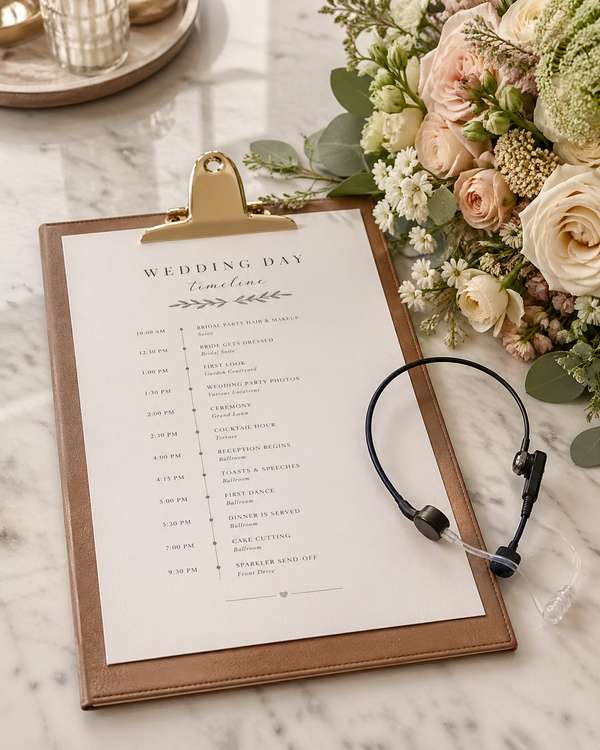
The three planner tiers
The industry uses overlapping terms here. Different planners describe the same service differently. Below is the way I think about it, based on what I actually watched planners do at weddings.
Tier 1: Day-of coordinator
What they do: Show up to the rehearsal, run the ceremony, manage the timing of the reception, handle vendor communication on the wedding day. They do not plan the wedding; they execute the plan you have already made.
Typical cost: $800-$2,500.
When you need one: Almost every wedding benefits from at least a day-of coordinator. The bride and groom should not be the ones answering the phone at 3pm when the cake delivery is delayed. The maid of honor and best man are guests with jobs to do (toast, support); they are not the right people to handle vendor crises during the reception.
When you can skip it: Very small weddings (under 30 guests) at venues that include their own coordinator (some boutique venues do). Or weddings at family member's homes where a family designee can run the day.
What they need from you: A complete vendor list with contact info. A timeline. A floor plan. The contact info of two or three "decision-makers" they can ask if a question arises.
Tier 2: Partial planner
What they do: Help with vendor selection (often providing a curated short-list of recommended vendors in your area), coordinate vendor contracts, build the timeline, manage the rehearsal and the day-of. Most of the planning decisions are still yours; the planner is providing structure and vendor connections.
Typical cost: $3,500-$8,000.
When you need one: You are planning your own wedding (location, design, food choices) but want professional help with the logistics layer. You are working a demanding day job and do not have the time to vet four caterers and three photographers personally. You have specific design ideas but need a coordinator who can translate those into a timeline that works.
When you can skip it: You are detail-oriented and have time to manage the project yourself. You have a friend or family member with event-coordination experience who can play the planner role. Your venue and caterer offer extensive support.
What they need from you: Your overall vision (rough). Your budget. Your priorities (what you care about most; what you are willing to compromise on). They will fill in the rest.
Tier 3: Full-service planner
What they do: Everything. From venue selection forward. They source vendors, they negotiate contracts, they design the wedding, they manage the timeline, they execute the day-of. The couple's role is to make decisions and approve. The planner does the work.
Typical cost: $12,000-$30,000+ for the planner's fee alone (does not include the wedding budget itself, which the planner manages on the couple's behalf). Some full-service planners charge a percentage of the total wedding budget (typically 12-18%) instead of a flat fee.
When you need one: Weddings over 200 guests. Destination weddings (especially international). Multi-day weddings (rehearsal dinner + welcome party + wedding + farewell brunch). Weddings with significant design complexity (custom installations, ambitious floral programs, large entertainment setups). Weddings where both partners have demanding careers and cannot meaningfully plan the wedding themselves.
When you can skip it: Weddings under 150 guests with a simple format. Couples with strong personal vision who want to do the planning themselves. Weddings at venues that provide significant in-house planning support.
What they need from you: A budget. A general aesthetic direction. Your willingness to delegate. The full-service planner relationship works only if the couple genuinely defers decisions; couples who want to micromanage a full-service planner often pay full-service prices for partial-service value.

What planners actually do day-of
Regardless of tier, the day-of work is similar. This is what good planners are doing while you are getting married.
Pre-ceremony:
- Arriving 4-6 hours before the ceremony to oversee setup
- Coordinating with the venue, caterer, florist, and rental delivery
- Confirming vendor timing with each crew chief
- Checking the ceremony layout (chair count, aisle width, altar position)
- Walking through the timeline with the officiant and the bridal party
- Handling any vendor issues that arise (late delivery, missing items, scope mismatches)
Ceremony:
- Cueing the wedding party for processional
- Coordinating music start with the DJ or string ensemble
- Cueing the recessional
- Managing transition from ceremony to cocktail hour
Reception:
- Cueing the DJ or band for grand entrance, first dance, parent dances
- Coordinating with the caterer on dinner service timing
- Cueing toasts at the right moment
- Managing the cake-cutting timing and announcement
- Handling vendor questions throughout (caterer asks how long until cake; the planner answers, not the bride)
- Solving problems as they arise (the AC stopped working; the planner finds the venue manager)
End of night:
- Coordinating breakdown with vendors
- Ensuring rentals are returned to the right place
- Collecting gifts, cards, and personal items
- Handling vendor tips if you have left envelopes
- Ensuring the couple has a way home and any leftover items make it to the right destination
The list above does not happen well without a planner. It happens chaotically. Either someone untrained gets pulled into running it (the maid of honor, a parent, the mother of the bride), or it does not get coordinated and pieces fall through.

Cost ranges and what to expect
The pricing varies wildly by region. Major coastal markets (NYC, LA, San Francisco) run 30-50% higher than mid-American ranges. Below are mid-American baselines.
Day-of coordinator pricing (mid-2026)
- Solo coordinator, smaller wedding: $800-$1,500
- Coordinator with one assistant: $1,500-$2,500
- Coordinator with assistant and travel: $2,000-$3,500
- Major-market premium: add 30-50%
Partial planner pricing (mid-2026)
- Standard partial-planner package: $3,500-$5,500
- Higher-end with more vendor curation: $5,000-$8,000
- Major-market premium: add 30-50%
Full-service planner pricing (mid-2026)
- Mid-tier full-service: $12,000-$20,000
- High-end full-service: $20,000-$40,000
- Celebrity-tier or destination weddings: $40,000-$100,000+
- Major-market premium: add 30-50%
These numbers are the planner's fee only, not the cost of the wedding the planner is producing.
What to look for when interviewing a planner
The consultation is the working interview. A few signals to watch for.
Real portfolio of recent weddings. Not a stock-photo gallery. Real photos with vendor credits. Ask for client references and follow up on at least one.
Clear pricing structure. A planner who will not quote without a deposit is a flag. The good planner explains their pricing transparently. Before you sign, read the deposit and cancellation terms carefully; the FTC's guidance on wedding and event contracts is a good plain-English primer on what to watch for.
Specific questions about your wedding. The good planner asks about your venue, your guest count, your priorities, your conflicts (family complications, scheduling constraints), your budget. They listen more than they pitch.
Vendor relationships, but not lock-in. The good planner has relationships with photographers, florists, caterers, and DJs in your area, and recommends vendors who fit your aesthetic and budget. The bad planner only recommends vendors who pay them kickback fees and refuses to consider others.
Capacity for your wedding. Ask how many weddings they have already booked for your weekend. The right number is one or two. More than three is a flag.
Backup plan for illness. Same question as for any wedding-day vendor. Who covers if they get sick the week of?
For the broader vendor evaluation framework, see Red Flags When Interviewing Wedding Vendors.
When NOT to hire a planner
A few honest scenarios where a planner is the wrong call.
Backyard or family-home weddings under 50 guests. Often run by family designees and friends. A planner adds cost without adding meaningful coordination value at this scale.
Couples with one partner who is a project manager by trade. A wedding is essentially a project with a fixed deadline. A skilled project manager can run it. Many do.
Venues with strong in-house coordinators. Some hotels, resorts, and dedicated wedding venues include a venue coordinator who effectively performs day-of coordination. If your venue has this, a separate planner duplicates effort.
Eloping or courthouse weddings. No planner needed. Save the budget.
When you absolutely need a planner
The opposite list. Scenarios where skipping the planner is a real mistake.
Multi-day weddings. Rehearsal dinner, welcome party, wedding, farewell brunch. The logistics of coordinating four events in three days are beyond what most couples can manage themselves while also being the celebrants. Hire at least a partial planner.
Destination weddings. Especially international or to remote locations. The local-knowledge gap is too wide to bridge from email and phone. Hire a destination-savvy full-service planner.
Weddings over 200 guests. The vendor count, timing complexity, and risk of things going wrong scales rapidly with guest count. At 200+ guests, the planner pays for themselves in stress avoidance alone.
Weddings where both partners have demanding careers. If you and your partner are both working 50+ hour weeks, planning a wedding without help is a recipe for arrival-week burnout. Hire someone who has the time you do not.
Design-forward weddings. Custom installations, ambitious florals, theatrical reception programs. These need professional coordination both for vendor management and for execution. Hire a planner who specializes in design.
What I tell couples who ask me
If your wedding is mid-size (50-150 guests) at a standard venue with conventional design, hire at minimum a day-of coordinator. The $1,200-$2,500 spend pays back in the bride and groom not having to manage vendor problems on the most stressful day of their lives.
If your wedding is more complex than that (large, multi-day, destination, design-forward), upgrade to a partial or full-service planner depending on how much of the work you actually want to delegate.
If you are still on the fence, ask yourself: who is going to handle the timing of dinner service while I am meeting the photographer for portraits? If the answer is "I will" or "my mom will," and that does not feel like a real plan, you need a planner.
Frequently Asked Questions
Do I really need a wedding planner?
Not always. Most mid-size weddings (50 to 150 guests) at a standard venue need only a day-of coordinator, who runs the timeline and handles vendor problems so the couple does not have to. You genuinely need a partial or full-service planner for large, multi-day, destination, or design-heavy weddings, or when neither partner has time to manage the project.
What is the difference between a wedding planner and a venue coordinator?
A venue coordinator works for the venue and manages the venue's staff, kitchen, and rules. A wedding planner or day-of coordinator works for you and manages all of your vendors across the whole day. They are not interchangeable. Even at a venue that includes a coordinator, you usually still want your own day-of coordinator.
How much does a wedding planner cost in 2026?
Day-of coordination runs about $800 to $2,500, partial planning $3,500 to $8,000, and full-service planning $12,000 to $30,000 or more for the planner's fee alone. Major coastal markets run 30 to 50 percent higher. Some full-service planners charge 12 to 18 percent of the total wedding budget instead of a flat fee.
When should I book a wedding planner?
Book a full-service planner first, even before the venue, ideally 14 to 18 months out, since they help you choose the venue. Partial planners and day-of coordinators are booked after the venue is set, usually 10 to 12 months out for popular ones.
Is a day-of coordinator worth it for a small wedding?
For weddings under about 30 guests, or at a venue that includes its own coordinator, you can often skip it and let a capable family member run the day. Above that size, a day-of coordinator is usually worth the cost because it removes vendor-management stress from the couple on the day itself.
Further reading
For the planner's place in the broader vendor sequence, see When to Book Each Wedding Vendor. For the budget framework, see Wedding Budget Allocation: What Percent Goes Where. For the questions to ask in vendor consultations, see Red Flags When Interviewing Wedding Vendors.
The Association of Bridal Consultants certifies wedding planners. Worth a quick check on their directory if you want to verify a planner's professional credentials.