How to Choose a Wedding Photographer: 8 Questions to Ask
How to choose wedding photographer? From twenty years working alongside wedding-day vendors.
Quick answer: Shortlist three photographers in your price range whose full galleries (not just highlight reels) you genuinely respond to, then ask each the same eight questions: how many weddings they shot last year, whether you can see a full similar gallery, their backup plan for illness, delivery time and format, second-shooter details, the cancellation clause, how they run family formals, and their arrival and hard-out times. Book whoever answers most directly with specific evidence of how they actually work. The middle-priced option with the cleanest answers is usually the right pick.
I did not photograph weddings. I did wedding florals for fifteen years, which means I worked maybe six hundred weddings standing five feet from the photographer at every key moment of the day. The arch I built for the ceremony, the tablescape I dressed for the reception, the bouquet I made that morning, all of it was photographed by someone I met two hours before. Some of those photographers were extraordinary. Some delivered work that made me wince when I saw the album later. The difference between the two groups was almost never about gear or about Instagram presence. It was about specific things, mostly invisible from the outside, that came up in the way they answered questions.
What follows is the eight questions I would ask if I were choosing a wedding photographer today, and what to listen for in the answer.
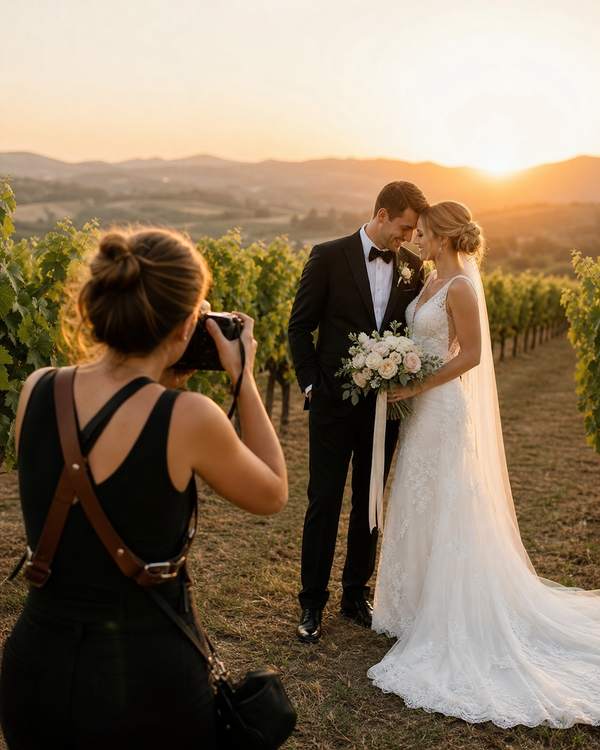
Question 1: How many weddings have you shot in the last twelve months?
The right answer is somewhere between fifteen and forty.
Below fifteen and you are buying somebody who is still learning the rhythm of a wedding day. Wedding photography is not the same skill as portrait photography or family-session photography. It is logistics, time pressure, low-light technical work, and reading family dynamics under stress, all happening simultaneously for ten hours. People who have not done it twenty times are still figuring out the choreography.
Above forty and you are buying somebody who is exhausted, who is treating your wedding as one of three this weekend, and whose attention will be elsewhere. The single best photographers I worked with consistently shot in the high twenties to mid thirties per year. Enough to be in flow. Not enough to be burnt out.
What to listen for: a real number. Not "a lot." Not "I've been doing this for years." If they cannot quickly answer a how-many-this-year question, they are not paying attention to their own pipeline.
Question 2: Can I see a full gallery from a wedding similar to mine?
Not the highlight reel. The full gallery. Five hundred to a thousand images from one wedding, ideally a wedding similar to yours in scale and lighting conditions.
The portfolio on a photographer's website is the best forty images they have ever taken. It is engineered to be impressive. It tells you almost nothing about whether they will deliver consistent work across the dozens of moments at your wedding that you actually want photographed.
A full gallery tells you everything. How does the photographer handle the dance floor when the lighting goes purple? Are family formals composed and exposed properly, or rushed and shadowy? Are there crisp images of the cake, the rings, the boutonnieres, or are those shots an afterthought? What does the dim reception venue look like in their hands?
If a photographer will not show you a full gallery, that is a flag. The reasons they give will be plausible (privacy, NDAs, gallery storage). The reality is usually that the full gallery has too many weak images.
What to listen for: willingness, ideally enthusiasm. The good photographers I knew kept several full galleries available specifically for this question.
Question 3: What happens if you get sick the week of my wedding?
Every working wedding photographer has a backup plan. Some have professional ones. Some do not.
The professional answer: "I have a contracted second shooter and two named backup photographers in my network with comparable experience. Here are their portfolios. If I cannot work, the backup keeps your deposit credit and shoots at the same rate. The contract specifies this."
The amateur answer: "I have never been sick in ten years," or "I would refer you to a friend," or some version of "we'll figure it out."
This question is the cleanest way I know to separate professional photographers from photographers who are still treating wedding work like a side business. The first kind has thought about the worst day. The second kind has not, and you do not want to be the wedding where they figure out their plan in real time.
What to listen for: a specific named backup, ideally with a portfolio they can show you on the spot.
Question 4: How long until I see the gallery, and what does delivery look like?
The honest range in 2026 is six to twelve weeks for the full edited gallery. Less than six is rare and usually means light editing or auto-editing. More than twelve is too long unless they have explicitly told you in advance.
Delivery format matters. The good photographers I worked with delivered through a professional gallery platform (Pic-Time, Pixieset, ShootProof, Cloud Spot) where you can browse, favorite, share, and download images at full resolution. The amateur ones delivered a Google Drive folder of zip files, which is what makes the album look like a hassle to you forever.
Ask specifically about the editing standard. "Lightly edited and color-corrected" is the floor. "Hand-edited individual files for the highlight set, batch-corrected for the rest" is normal. "Each image individually retouched" is rare and slow.
What to listen for: a number range, a delivery platform, and a clear distinction between highlight editing and full-gallery editing.
Question 5: Do you bring a second shooter, and what do they actually do?
For weddings over about 80 guests, a second shooter meaningfully improves the gallery. The math is simple: while the lead photographer is photographing the ceremony from the front, a second shooter is capturing reactions from the back. While the lead is doing family formals, the second is photographing cocktail hour. The two perspectives compound.
For smaller weddings (under 50 guests), a single photographer usually has enough time to cover everything well.
The question to ask: what is the second shooter's role and experience? Are they a contractor with their own portfolio, or is it the lead photographer's assistant who is mostly carrying gear? Both can be useful. They produce different kinds of galleries.
I worked with a second shooter who was actually an established lead photographer in her own right, working as a second on the day. The work she produced was a real second eye. I also worked with second shooters who were newly trained and produced almost nothing usable. The lead photographer should be honest about the difference.
What to listen for: clarity on the second shooter's role and ability to show their work specifically.
Question 6: What is your contract's cancellation and rescheduling clause?
Read this clause before you sign. Many couples skip it. The COVID era taught the industry to write better cancellation language, but you still see contracts with brutal language about non-refundable deposits, no-rescheduling-allowed terms, and weather-day clauses that favor the photographer.
What you want to see:
- A specific deposit amount that is non-refundable (this is normal and fair)
- A clear refund schedule for cancellations made beyond a certain window
- A reschedule clause that allows date change without forfeiting the deposit, subject to availability
- Force-majeure language that covers genuine emergencies (illness, weather, family death)
What is a flag:
- A "we keep all paid funds regardless" clause
- No reschedule provision at all
- Force-majeure language that benefits only the photographer
If the contract is unclear, ask for clarification in writing. Photographers who run their business well will have already thought through this. The FTC's consumer guidance on event contracts and deposits is a useful baseline for what fair cancellation and refund terms look like.
What to listen for: the photographer who hands you the contract proactively, points to the relevant clauses, and explains them, is the photographer who has been through enough situations to know this matters.
Question 7: How do you handle family formals?
The most underrated skill in wedding photography. Family formal time is the moment of the day when the photographer is herding twelve grandparents, three children under five, and several relatives who are mid-cocktail, into structured group shots that have to look natural.
Bad photographers wing this. The result is twenty minutes of chaos, with the photographer calling out names she does not know, looking at a list she cannot read, while children wander out of frame and elderly relatives lose patience. The shots come out tight, awkward, and missing key combinations.
Good photographers prepare. They ask you for a shot list two to four weeks before the wedding. They ask for one or two designated family members who will help wrangle people. They run formals in a specific order that flows naturally (grandparents first, while everyone else is still seated and accessible). They bring a printed list. They are decisive and warm at the same time.
This question is also a reasonable proxy for general organizational competence. Photographers who think about formals carefully tend to think about everything else carefully.
What to listen for: a specific process. "I send a shot-list questionnaire eight weeks before the wedding" is a complete answer. "We just figure it out on the day" is a flag.
Question 8: What time do you arrive, and what is your hard out?
This question matters more than couples realize. The answer reveals how the photographer thinks about the structure of the day.
Arrival: most contracted weddings start photography coverage at "getting ready" time, which is usually four to six hours before the ceremony. The photographer arrives during preparation to capture the dress, shoes, rings, mother fastening the necklace, the small details that will mean something to you in twenty years. If a photographer is contracted for ten hours of coverage and wants to start at the ceremony, you are giving up the morning images that often turn out to be the most loved later.
Hard out: most weddings run later than couples planned. The photographer's hard out determines whether the dance-floor images and the sparkler exit are part of the gallery. A 10:00 PM hard out for an 11:00 PM end of reception means no exit photos. Decide in advance whether the exit is part of what you want documented and contract accordingly.
What to listen for: a specific time, a specific reason. "I arrive ninety minutes before the ceremony to capture preparation, and I stay until the cake cutting unless we have contracted for the exit" is the kind of answer that tells you the photographer has thought about your day rather than reading the contract for the first time on the morning of.
What none of the eight questions are about
Notice what is not on the list: editing style, Instagram aesthetic, how many awards they have won, gear list, whether they shoot film or digital.
These are the things wedding-photography blogs and Pinterest articles tell you to evaluate. They are the things photographers themselves talk about most. They are also less predictive of whether your gallery will be good than the eight questions above.
Editing style is real but secondary. If you like the photographer's portfolio, you will probably like the editing. The decisions that make a gallery great or weak happen in the moments above (preparation, professionalism, organization, second-shooting, family formals, time discipline), not in the saturation curves applied afterward.
The Instagram aesthetic is a marketing surface. Many of the best wedding photographers I worked with had quiet Instagram accounts with thirty thousand followers and steady booking. The photographers with two hundred thousand followers were sometimes excellent, sometimes performing for the algorithm, and the bookings did not always reflect the work.
What I tell couples who ask me
If you are in the photographer-search phase right now, do this:
- Pick three photographers in your price range whose portfolios you genuinely respond to.
- Email each of them all eight questions above.
- Whoever answers most directly, with the most specific evidence of how they actually work, is the one to book.
- The cheapest of the three is rarely the right answer, and the most expensive is rarely either. The middle option, with the cleanest answers, is the one to pick.
The wedding-day photographs will outlast almost everything else from the day. The flowers I made wilted in three days. The catering was eaten in three hours. The photographs are still in your home, on your wall, in twenty years. Pick the photographer the way you would pick somebody to whom you are entrusting that.
Frequently Asked Questions
How much does a wedding photographer cost?
It varies widely by market, experience, and coverage hours, so ask each photographer for their package pricing directly. The more useful rule is that the cheapest of your three candidates is rarely the right answer and the most expensive rarely is either. The middle option with the cleanest, most specific answers usually delivers the best gallery for the money.
How many photos should I expect from a wedding?
A typical wedding gallery runs several hundred to over a thousand edited images, and you should ask to see a full gallery from a wedding similar to yours, not just the highlight reel. Expect the full edited set six to twelve weeks after the wedding. Anything faster often means light or automated editing.
Do I need a second shooter for my wedding?
For weddings over about 80 guests, yes. A second shooter captures reactions and parallel moments the lead photographer cannot, like guest reactions during the ceremony or cocktail hour during family formals. For weddings under 50 guests, a single experienced photographer usually has time to cover everything well.
When should I book my wedding photographer?
Most couples book nine to twelve months out, and popular photographers fill peak-season weekends first. Booking early protects your top choice. Before signing, read the cancellation and rescheduling clause carefully and confirm the contract includes a named backup plan if the photographer falls ill.
What questions should I ask a wedding photographer before booking?
Ask how many weddings they shot in the last twelve months, to see a full gallery from a similar wedding, what their backup plan is if they get sick, how long delivery takes, whether they bring a second shooter, what the cancellation clause says, how they run family formals, and their arrival time and hard out. Listen for specific answers rather than vague reassurances.
Further reading
For the broader vendor-selection picture, see When to Book Each Wedding Vendor: A Planning Timeline and Red Flags When Interviewing Wedding Vendors.
The Wedding Photojournalist Association publishes editorial guides on documentary wedding photography that pair well with the questions above.